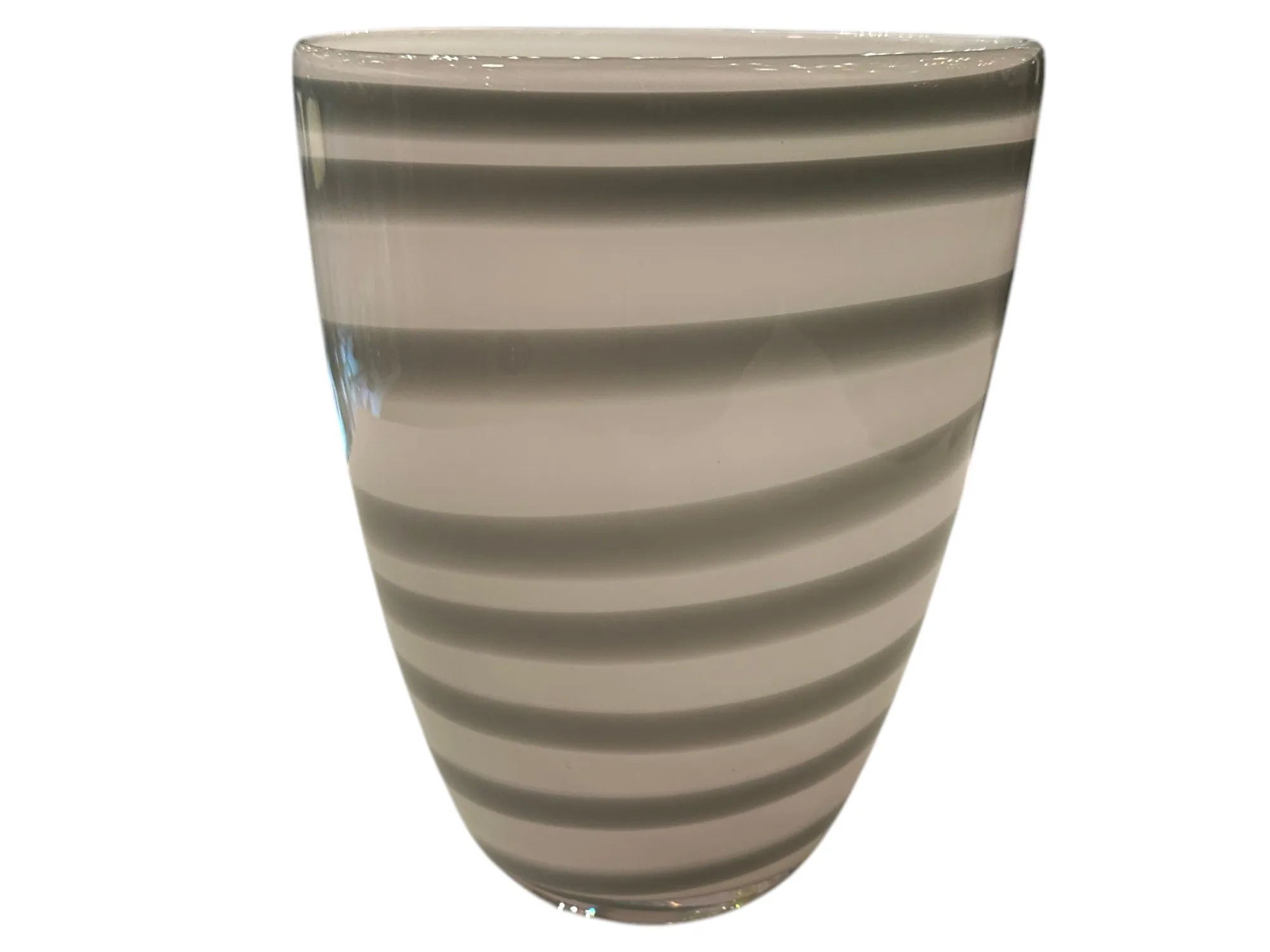
It is a decorative technique from Murano based on the integration of bands or stripes of color.
It reached its peak expression in the Mid-Century Modern design during the 50s and 60s. It was popularized by iconic firms such as A.V.E.M., Fratelli Toso, and Barovier & Toso.
The process begins by making strips or rods of colored glass (canne or fasce). It uses transparent pigments, intense colors, or opaque glasses like lattimo (milky white).
The glass stripes are organized in parallel or concentric patterns on the work table. They are placed on a heated metal or stone plate to avoid thermal shocks.
A mass of incandescent glass over the cane is rolled with pressure over the strips. The molten glass from the core adheres to the stripes arranged on the smooth surface.
The piece returns to the glory fire to fully integrate the seams without seams. It is turned and worked manually until achieving a homogeneous cylinder with the pattern.









 Share